Category Archives: Uncategorised

Block 3 – Week 3 authentic digital learning experience for students

Herrington and Kervin discuss the principles of authentic learning with technology in the 2007 paper “Authentic learning supported by technology: Ten suggestions and cases of integration in classrooms.” The use of cases within the literature assists my visualisation and understanding of how I can implement these principles in my own teaching.

One principle that I can utilise to create an authentic digital experience for students is the expert performance. Expert performance is the opportunity for students to witness a task/procedure being demonstrated by a professional (for example a clinician), prior to it being practised independently by the candidate. Students’ of BSc Oral Health Sciences often echo Herrington and Kervin’s (2017) observation that it is;

“Much easier to learn a skill or concept when they see it demonstrated by an expert.”  (Herrington, Kervin, 2007)

When students begin learning the process of tooth restoration, I have previously tried to demonstrate the technique using a mannequin situated in front of small groups.  Visibility is lessened by using water from the high-speed drill and the limitations of the camera equipment. Students observing the demonstration may only be able to view the tooth clearly after a stage of restoration is completed. This diminishes the effectiveness the video demonstration as it fails to allow the student to see how the cavity preparation is achieved. Expert performance on a small group has been used to some degree but it has not been as successful without use of technology. Due to the confined nature of the working environment, an ideal location for recording equipment is mounting a camera on an overhead light with the ability to zoom in on the active working site. It is also important that the lecturer demonstrating can view what is being recorded on a screen. When carrying out dental procedures hands and equipment frequently obscure the direct view of the camera. Utilising a teaching screen allows the clinical demonstrator to adjust their position thus ensuring an uninterrupted view for students.

The creation of a well filmed video/vodcast would eliminate the visual difficulties that students are currently experiencing.  The video would demonstrate the clinical procedure using a camera in a fixed position that would capture all movements by the “expert”(Herrington, Kervin, 2007). This vodcast/video would be posted to LEARN for students to watch prior to the practical skills session which would include a voice over description and rationale for actions and steps within the procedure. Students that utilise this resource will benefit from the opportunity to view the process in advance, thus allowing more ti

me to physically practice the skill without a significant proportion of the clinical skills session being used up by a lecture.

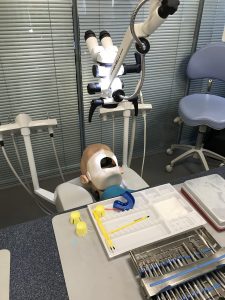
(Pictured is a mannequin that students practice skills on. A camera could be mounted on the microscope pictured above the head to allow uninterrupted filming of the procedure.)

After viewing the video, a question would be posted to promote student discussion of patient factors that may impact on the procedure. It is important that students can identify human variants and their impact on the process and how it is carried out. This is vital as variants such as saliva contamination cannot be emulated on a mannequin head but pose a significant issue that must be managed by the students when handling real patient cases.

Following the practical skills session students would have the opportunity to post photographs of practical work they have carried out on their mannequin and share within an online discussion board. In addition, students would also give feedback on the work of their peers. This would promote reflection, critical analysis and development of students’ abilities to recognise potential failings of restorations. In addition it would provide an opportunity to commend, encourage and support their peers.

UKPSF Dimensions covered – A1, A2, A3, A4, V1, K1, K2, and K4.

Reference List

HERRINGTON, J., KERVIN, L. (2007). Authentic learning supported by technology: Ten suggestions and cases of integration in classrooms. Educational Media International. 44(3). Pages 216-236.  [online]. Available from: http://citeseerx.ist.psu.edu/viewdoc/download?doi=10.1.1.657.1044&rep=rep1&type=pdf  [Accessed 18 Feb 2018]


Picture taken by Lucy Wands – Clinical Skills Room 1, 2nd Floor, Edinburgh Dental Institute.

Block 3 Week 2 – Authentic Assessment

Within BSc OHS there are many assessment styles I have experienced as an assessor. Our students are assessed in the well-recognised written summative paper style demonstrating factual knowledge. In other areas of the subject, we assess students via a simulated patient case where candidates utilise experience and knowledge to demonstrate ability to treat patients effectively.

Sambell et al. discusses the “principle of authenticity” in chapter 1 of Assessment for Learning in Higher Education 2013, which has led to me consider which attributes of authenticity our assessments promote. I will discuss the authenticity of one of the assessments we set for the year three cohort.

Within the module of Preparation for Practice we now assess students by assigning a public health topic which the student must research and design a poster on.  A date is then set where the posters are presented by the candidate in a ten-minute presentation. Students are graded not only on the poster content and appearance, but also on their presentation skills i.e.. eye contact and audience engagement.

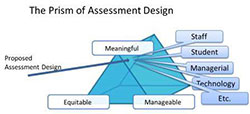
Using the Prism of assessment design (Saunders, 2014) I want to measure the “authenticity” (Sambell et al., 2013) of this approach to assessment.

Meaningful

A meaningful assessment is one that assists students to achieve the learning objectives (Biggs, 1996). One of the learning objectives for Preparation for Practice;

“Communicate appropriately, effectively and sensitively by spoken, written and electronic methods and maintain and develop these skills.”

In my opinion the poster assessment is an opportunity to develop communication skills when presenting to the assessors and peers. It is also an opportunity for students to think creatively using digital methods to convey a health message and information which is an integral role of a Dental Hygienist and Therapist.

Equitable

An equitable assessment is one which the “reward is proportional to the effort put in and the skills demonstrated”(Saunders, 2014). In my opinion, students feel motivated to produce high quality work as it is assessed by their peers, lecturers and external examiners. The marks awarded for this assessment count towards the students’ degree classification, thus again motivating students to produce high quality work and presentations. The students may wish to include the poster within a portfolio for future employment applications. It could also be used as an example of independent literature-based research which would support discussions within an interview setting. The BSc programme is often contacted by dental companies and professional bodies offering students opportunities to showcase academic work in a competition. In addition to the prestige of placing in a competition, students may benefit from recognition of their work by the judge (dental/professional body) being detailed within a portfolio for employment applications.

Manageable

For an assessment to be deemed “manageable” it must be “completed and marked in a timely manner, without undue stress for staff and students”(Saunders, 2014).  As a team we collectively developed a marking criterion which was shared with students indicating what is required to perform well in this type of assessment. Staff utilise this grid when first viewing the posters and whilst listening to the presentations. A team meeting is held immediately after the presentations and staff discuss their comments and agree on a mark for each category.  Having protected time soon after the presentation aids marking as it is still fresh in the assessor’s memory. The only time issue in giving results is the timing of exam board as no results are issued until after ratification.

I feel this is assessment succeeds in many aspects of the Prism of assessment design, however there are many other assessment styles that are utilised in the discipline that do not fulfil the criteria. As I progress through block three I hope to develop a deeper understanding of assessment design that can be used to improve all our undergraduate assessments to emulate authentic attributes.

UKPSF Dimensions covered – A3, A5, V3, V4

References

Biggs, J (1996), ‘Enhancing teaching through constructive alignment’, Higher Education Research & Development, 32(3), pp. 347-364. Available at: http://www.tandfonline.com/doi/citedby/10.1080/0729436990180105?scroll=top&needAccess=true (Accessed: 06 Feb 2018).

Sambell, K., McDowell, L., and Montgomery, C (2013), ‘Chapter 1. Designing Authentic Assessment’, Assessment for learning in higher education [electronic resource], pp. 10-31. Available at: https://www.dawsonera.com/readonline/9780203818268 (Accessed: 14 Feb 2018).

Sauders, F (2014), ‘Designing assessments that are meaningful, equitable and manageable in UK higher education’, Higher Education Academy. Available at: https://www.heacademy.ac.uk/blog/designing-assessments-are-meaningful-equitable-and-manageable-uk-higher-education [Accessed 14: Feb 2018]


Block 3 Week 1 – Constructive Alignment

For this blog I want to consider the following;

How can the principle of Constructive Alignment (Biggs, 1999) (CA) be implemented in teaching of BSc Oral Health Sciences?

The concept of CA is one in which the student “constructs his or her own learning” and the teacher creates a “Learning Environment”(LE) thus ensuring that the teaching and assessment are parallel with the “desired learning outcomes.”(Biggs, 2017)

The BSc Oral Health Sciences programme, as I have mentioned in other blogs, is required to deliver the curriculum framework set by General Dental Council. Historically this has been delivered solely in lecture format and, on reflection, I consider myself to be managing lecture content rather than “facilitating” student learning.(Biggs,1999) In the module Health and Disease (H&D) the factual content of the subject is weighty and most of the material is completely new information for the student. It is also one of the first modules introduced to students via lectures where the learning outcomes are stated and the lecture slides contain all content necessary for passing examinations and meeting GDC requirements.

H&D module, in my opinion, does not achieve the concept of constructive alignment. The first element of constructive alignment is that the students create their own understanding of the concept. This creation of knowledge, which is specific to each student, is facilitated by a “learning activity”. (Biggs, 2017) Current lecturing and teaching methods of H&D do not deliver an effective “learning activity”. Without prior knowledge, students struggle to engage with the content of the lecture and the session is an information overload. Students find the lecture environment overwhelming and do not feel comfortable enough to participate in discussion or questions, because they have not had enough time to process the information delivered.

The second element, alignment, is not fully achieved in the teaching and assessment of H&D. As discussed above, teaching style utilised in H&D is not conducive to student understanding and construction of knowledge. The current assessment format for the module H&D does not align with the desired learning outcomes. The assessment comprises of a written paper with six 20-mark question and students lose significant marks if they are questioned on a topic that they may not have learned at an adequate depth. They often resort to learning lecture slides verbatim, which they regurgitate in the exam. The questions are designed for students to showcase their memory skills, while understanding would be assessed more efficiently with a problem-based scenario. This would allow examiners to determine student’s depth of knowledge by their ability to apply their understanding to solve the issue posed. (Biggs, 2017)

I will begin to implement new teaching techniques, as learned from PGCAP to ensure my teaching is critically aligned. After experiencing my first online collaboration with PGCAP, I now identify this as a possible LE to utilise in course design. I felt the use of online conversation, as well as audio interaction, allowed discussion to flourish within the group.  Inclusion of this within the LE would promote peer learning through discussion particularly with students who struggle to find their voice in class.

An integral part of engaging with the LE is the preparation by the student. As a teacher, I would pose a question to be considered and each student would be invited to present their findings and opinions. This is an opportunity for students to develop skills in critical analysis and reflect on the feedback they receive from peers. I anticipate that, as a result of these changes, students will develop a deeper knowledge of the subject area than they would in a passive lecture.

I will continue to research other methods of assessment so that I can holistically achieve constructive alignment by employing teaching activities and realistic assessment styles.

UKPSF areas covered: A1, A4, K2, K4, V2

References

Biggs, J (2017), ‘Aligning teaching for constructing learning’, The Higher Education Academy. Available at: https://www.heacademy.ac.uk/system/files/resources/id477_aligning_teaching_for_constructing_learning.pdf  (Accessed: 06 Feb 2018).

Biggs, J (1999), ‘What the Student Does: teaching for enhanced learning’, Higher Education Research & Development, 1(18), pp. 57-75. Available at: http://www.tandfonline.com/doi/citedby/10.1080/0729436990180105?scroll=top&needAccess=true (Accessed 06 Feb 2018).

Additional Reading 

Medhat, K. (2017) ‘Teaching Matters blog’, The University of Edinburgh. Available at: https://www.teaching-matters-blog.ed.ac.uk/?p=2087 (Accessed: 09 Feb 2018).

Block 2 – Threshold Concepts

When I initially read Cousin’s “An introduction to threshold concepts” I struggled to relate the concept to my discipline and confused concept with a subject division. I reached out for guidance and was introduced to “Threshold concepts in dental education” (Kinchin, et al 2011) which perfectly illustrates how identification of threshold concepts (TC) in a curriculum can positively change the way in which we deliver clinical dental education.

When I think of the word “threshold”, I think of a vast building that I want to explore, but first I must pass the threshold to access these areas.

I find this image helps me to understand the role of TC in dental education, that once students have understood and “pass the threshold” they can expand their knowledge and explore that topical area.

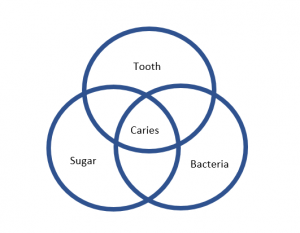
A TC that is well taught within BSc Oral Health Sciences (BSc OHS) is the caries triad. Caries is a multifactorial disease which requires a susceptible tooth, dietary sugar and bacteria to commence. When educating students of this concept we use the following imagery.

Removal of any one factor as illustrated stops the carious process from occurring or continuing to progress. Once students understand this relatively straightforward concept they can research any of these factors such as species of bacteria, and diet advice for minimising sugar intake. The further research will aid students with patient education which is integral task in their role as Dental Care Professional.

Compared to this easily relatable and readily understood aetiology of the carious process, students struggle with the concept of bonding in restorative dentistry. Students are keen to learn the procedure of tooth restoration due to the rewarding results for clinician and patient. Kinchin et al discuss the “experiential/linear” knowledge structure and “chains of practice that are reinforced by the sequential nature of clinical procedures”, restorative dentistry is an example of such a procedure. Students learn the step-by-step process from caries removal, cavity design, selection of material and placement. By teaching in a sequential fashion, students struggle to adapt their knowledge in order to treat difficult human variants that may arise during real life treatment.

To facilitate students ability to recognise why restorations may fail and how to avoid this, the introduction of TCs is a viable option. For example, a threshold concept within restorative dentistry that I’ve identified is the process of bonding and creating a micromechanical lock. Students confidently remember its place within the sequential process but are often unaware of the crucial importance of this step for the success of the filling. Once the concept bonding is understood, students can expand their knowledge in the area of creating a compatible surface to the variant strengths and weaknesses of bonding products available. With the ability to expand on the concept students will be able to critically evaluate advances in dentistry due to the knowledge grounding from a TC.

In my opinion, TCs are an innovative way to develop curriculum and as I progress through PgCAP to block three, I feel TC could be a key factor to consider when developing a course with regards to knowledge transmission.

An effective method to implement the integration of TCs is the use of flipped classroom (FC) (McQueen, 2016). By means of a recorded lecture you could introduce a TC such as caries triad which students would be required to watch prior to the FC session. Students would then be required to carry out independent research on a factor of the triad such as bacteria species which they will present to the group in the FC session. This also gives the lecturer opportunity to ensure all content is still covered in line with GDC standards and less need for monotonous lecturing for hours on end. van Vliet, Winnips and Brouwer (2015, 2014) research shows that by addition of flipped lecture to;

“one of the five traditional lecture sessions per week appeared to be sufficient to achieve changes in learning strategies of students towards deep-learning strategies”.

This is a manageable target in the implementation of flipped classroom which I can integrate into the discipline and continue to engage and enrich student learning.

UKPSF Framework Dimensions covered – A1, A2, A4 and V3

Reference List

Cousin, G. (2006) ‘An introduction to threshold concepts’, Planet, 17(1), pp.  4-5. Available at: http://www.tandfonline.com/doi/pdf/10.11120/plan.2006.00170004?needAccess=true (Accessed: 14 Dec 2017).


Kinchin, I. M., Cabot, L. B., Kobus, M. and Woolford, M. (2011), ‘Threshold concepts in dental education’, European Journal of Dental Education, 15, pp. 210–215. Available at: http://onlinelibrary.wiley.com/doi/10.1111/j.1600-0579.2010.00660.x/full (Accessed: 09 Jan 2018).


McQueen, H. (2016) ‘Teaching Matters blog’, The University of Edinburgh. Available at: http://www.teaching-matters-blog.ed.ac.uk/?p=888 [Accessed: 19 Dec 2017). 


Van Vliet, E. A., Winnips, J. C., &and Brouner, N. (2015), ‘Flipped-Class Pedagogy Enhances Student Metacognition and Collaborative-Learning Strategies in Higher Education But Effect Does Not Persist’, CBE Life Sciences Education, 14(3), ar26, pp. 1-9. Available at: http://doi.org/10.1187/cbe.14-09-0141 [(Accessed 04 Jan 2018).

Door picture – Available at creative commons no attribution required

https://pixabay.com/en/door-open-door-lock-design-brings-1845682/

Triad diagram – Made independently by Lucy Sheerins on Word


Additional Reading

Åkerlind, S. (2004), ‘A new dimension to understanding university teaching’, Teaching in Higher Education, 9(3), pp. 363-375.  Available at: https://doi.org/10.1080/1356251042000216679 (Accessed: 07 Dec 2017).

Personal Academic Development Plan (1st Draft)

Academic (research and teaching) vision for the next five years

My vision for the next 5 years is to complete PgCAP and become a fellow of the HEA. On completion I hope to obtain a permanent lecturing contract with the University of Edinburgh. To further support my application for a lecturing position, I wish to embark on research project or an MSc concerning BSc Oral Health Sciences (OHS) student diversity. I have a particular interest in the educational background of students who embark on the course and the factors that affect their success within the discipline. I would hope that this research could be utilised to target and support students and reduce dropout rates.

Teaching and Research Objectives

In 2016 I was appointed as a lecturer for BSc OHS on a secondment basis. Since then I have had opportunity to teach in a variety of mediums; “traditional” lecturing transmission of information (Åkerlind, 2004), clinical practical skills development, and clinical patient supervision. Students generally engage well in the practical aspects of the curriculum highlighted in the BSc (Hons) OHS Student Midterm feedback (Y1-3):

“helps build confidence” and “closely resembles treatment you will carry out”.

However, in other theoretically heavy “threshold concepts” (Cousin, 2006) such as Health and Disease, students reported;

“Overwhelming amount of information” and requested “more interactive lectures” such as “short quizzes”.

One of my teaching objectives is to introduce different techniques for knowledge transfer in the theoretical concepts of the discipline.

An estimated 30% of my teaching time is occupied supervising students on patient clinics. Feedback is given privately to students for each appointment immediately following completion. My next teaching objective is to further improve my formative feedback skills to ensure that students have specific and achievable targets to strive towards.

During my undergraduate studies academic writing opportunities were limited due to the absence of an honours year.  I now want to develop my skills writing at an academic level to enable myself to provide high quality support to my undergraduate students. When advising students on their dissertations and literature reviews, I often consult colleagues for advice on my summative feedback as they are more experienced.  I hope that as my experience of writing assignments for PgCAP progress, I will need to rely less on my colleagues for continual support.

Boyd and Smith state that;

“the majority of university lecturers in the health professions have been appointed on the basis of their successful first career in clinical practice” and that have “little or no direct experience of involvement in research activity” (2016).

I agree with this statement following the PgCAP orientation days where I met many academics working in other disciplines who demonstrate vast experience in research. Therefore, my objective is to embark on collaborative research with colleagues in my discipline to examine student diversity issues within BSc OHS and resulting employment as Dental Care Professionals.

This year I have been appointed as Personal Tutor to 2017-2018 Y1 BSc OHS. During the last academic year, a significant number of our students embarked on the appeal process. This lead the discipline to reflect on the standards of our Euclid notes and how we approach student’s academic and personal issues. We are fortunate to have very small cohorts of students, improving our ability to recognise quickly when issues arise. My objective is to better understand what students require from their PT and how best to carry out these duties from the pastoral and counselling services available.

Campaign plan for achieving these objectives

In response to student feedback, my campaign plan includes the implementation of newly researched knowledge transfer techniques such as Top Hat (Galloway, 2017), Qwectures and flipped lectures (McQueen, 2016). I will continue to attend IAD development courses and utilise the teaching matters blog for advice and examples of these techniques in action. I will share successful techniques with my team to collectively improve student engagement, thus making my colleagues key beneficiaries within my plan.

Particular to Oral Health Sciences, I hope to utilise available resources of 3D anatomy suite and the video camera in clinical skills to improve student engagement in this curriculum area. To achieve this, I will allocate protected time to receive training on use of these technical facilities. Last semester, I trialled a restorative handbook for semester one of Y2. From experience of the previous academic cycle, I noticed gaps in continuity and uniformity when teaching students restorative skills. The handbook contains diagrams, examples, tasks and lectures that are delivered throughout the semester. I included space for students to reflect on each session within clinical skills, however I rarely witnessed this being utilised. My campaign plan is to obtain feedback from colleagues and students on how to improve the handbook efficiency. Personally, I have already identified the need for lecturers to give formative written feedback on tasks carried out, which may in turn encourage students to utilise the space for reflection.

Regarding formative feedback, I plan to develop a template for this on clinics. Feedback is currently given verbally by the supervisor and is recorded by the student. The supervisor must electronically sign off the reflective account but there is only room for comment if a low grade has been given. When I think back to my undergraduate training, I valued direction and used it to improve, however positive comments were verbal and rarely recorded. Allowing the supervisor to add comment, regardless of the grade outcome, may support those students who often feel they are only ever given critical feedback.

I recently met with my personal tutor for PgCAP to discuss the optional courses. I greatly appreciated the advice and guidance given and have chosen the optional course “Researching your teaching” where I hope to develop my research skills. The course assignment is to write a research proposal, which I intend to be in dental education and student diversity. I will seek advice from colleagues who have completed their masters on how to relate my research proposal to the discipline. I hope there may be potential opportunities for collaboration on a research project with my colleagues, post PgCAP completion.

Identification of key beneficiaries, collaborators and partners

In no hierarchical order, the key beneficiaries within my plan are the discipline, colleagues, students and myself.

I anticipate that BSc OHS will benefit through on going course development and ensuring lecture content continues to be in line with current advances in dentistry and teaching techniques. Colleagues will benefit from the sharing of acquired knowledge from PgCAP and collaborative opportunities that may arise when I embark on dental education research.

Conceivably the most important beneficiaries of my personal plan are the undergraduate students within the course. Evidence of course adaptations made in response to student feedback, will ensure students feel their input is valued and encourage an “ethos of respect” (Kreber, 2010). Through improvements in teaching styles using the technology previously mentioned, verbatim “mimicry” (Cousin, 2006) of lecture content by students should decline, as they demonstrate a deeper level of understanding. Students often express stressed emotions regarding coping with discipline content especially before examinations. Through further PT training and collaboration with colleagues, I will be better equipped to assist and support students in need of academic and personal guidance at these times.

Personally, I feel I will benefit from the opportunity to begin building my academic identity (Kreber, 2010) and reputation within dental education. I have entered a post in academia relatively early in my career and plan to utilise PgCAP as an opportunity for further academic development.

Key challenges, opportunities and funding

September 2020 is the expected completion date of my secondment. I am fortunate to have the opportunity to complete PgCAP during this time frame however, I expect that the progression of research may extend beyond this date.

Development of the course content is necessary and continuous as the discipline is governed by the General Dental Council (GDC) standards framework. Curriculum is set by the GDC and must be accurately taught, currently by traditional lectures. When adopting new teaching methods, the challenge is to ensure accuracy of information students receive whilst encouraging them to further their learning through independent research.


UKPSF Framework Dimensions covered – K4, K5, V1, V3, V4


References

ÅKERLIND, S. (2004) A new dimension to understanding university teaching. Teaching in Higher Education. 9:3, pages 363-375. [online]. Available from: https://doi.org/10.1080/1356251042000216679 [Accessed: 07 Dec 2017]

BOYD, P., SMITH, C. (2016) The contemporary academic: orientation towards research work and researcher identity of higher education lecturers in the health professions. Studies in Higher Education. 41:4, pages 678-695. [online]. Available from: https://doi.org/10.1080/03075079.2014.943657 [Accessed: 07 Dec 2017]

COUSIN, G. (2006) An introduction to threshold concepts. Planet. 17:1, 4-5, pages 4-5. [online]. Available from: http://www.tandfonline.com/doi/pdf/10.11120/plan.2006.00170004?needAccess=true [Accessed: 14 Dec 2017]

GALLOWAY, R. (2017) Teaching Matters blog [online]. The University of Edinburgh. Available from: http://www.teaching-matters-blog.ed.ac.uk/?p=1533 [Accessed: 19 Dec 2017]  

KREBER, C. (2010) Academics’ teacher identities, authenticity and pedagogy. Studies in Higher Education. 35:2, pages 171-194. [online]. Available from: https://doi.org/10.1080/03075070902953058 [Accessed: 06 Dec 2017]

McQUEEN, H. (2016) Teaching Matters blog [online]. The University of Edinburgh. Available from: http://www.teaching-matters-blog.ed.ac.uk/?p=888 [Accessed: 19 Dec 2017]  


Further Reading

BOMBERG, E. (2016) Teaching Matters blog [online]. The University of Edinburgh. Available from: http://www.teaching-matters-blog.ed.ac.uk/?p=198 [Accessed 06 Dec 2017]

BREW, A. (2010) Imperatives and challenges in integrating teaching and research. Higher Education Research & Development. 29:2, pages 139-150. [online]. Available from: https://doi.org/10.1080/07294360903552451 [Accessed: 07 Dec 2017]

 

Welcome to your blog

Lucy Sheerins BSc Oral Health Sciences Lecturer at the University of Edinburgh.

My position as lecturer is on a secondment basis which was recently extended from completion in September 2017 to September 2020. In light of this extension, I was granted the opportunity to  develop my skills as a post graduate student on the PgCAP course.

Prior to my secondment with the University of Edinburgh, my background is practising as a Dental Hygiene Therapist for NHS Lothian Health board. Whilst I thoroughly enjoy the challenges and work life diversity that lecturing brings, from time to time I miss the patient contact I had built over my three years in Lothian.

BSc Oral Health Sciences is a four year honours degree programme which on completion the candidate will obtain a qualification in Dental Hygiene and Dental Therapy.  Dental hygienists-therapists are an integral part of the wider network of Dental Care Professionals.  Dental hygienist-therapists can carry out 70% of dental treatment from primary tooth extractions to adult restorations. Post qualification, employment rates are good with graduates accepting positions in practice or with health boards.

Currently, my teaching involves lectures to small cohorts of no more than eleven students, demonstrations and supervision in clinical skills setting and on patient clinics. My academic interest is in the diversity of students, especially the gender balance within our student intake, currently there is only one male student within BSc Oral Health Sciences. 

Through attending the course, I want achieve better techniques for delivering lectures whether that be through multimedia options or reviewing my delivery style. I am certain through attending the foundation days I will be inspired to improve my understanding of the role of a lecturer and identify other areas of improvement I may have not considered.

I thoroughly look forward to meeting everyone on PgCAP this coming Monday.