
Reflective practice is an appealing topic for discussion in block two, being a familiar concept within my professional discipline. Reflection on clinical practice is an integral part of the professional registration and practice of a Dental Hygiene Therapist. I originally believed my experiences of being a reflective practitioner would transfer well to PGCAP and my academic role.
Reflection as a dental practitioner is the process of reviewing one’s patient practice. This can be done on a case-by-case basis, reflecting on areas of success and others in need of improvement. The personal findings are used to plan training and continuous professional development for the GDC five year CPD cycle and career development.
From journals, there are similarities between reflection in a clinical environment and teaching. The depth of self-analysis and challenging one’s own beliefs of teaching, is when an academic adopts the status of a “critically reflective practitioner”. (Larrivee, B. 2000)
One of the similarities between reflection as a practitioner and a critically reflective teacher is that it is an infinite process. (Larrivee, B. 2000) Critical reflection can be adapted to any aspect of professional or personal life and reviewed on a frequent basis, to celebrate success and identify areas for improvement.
It was evident in the literature from Larrivee (2000) that there is considerable “depth” required to achieve critical reflection and the;
“sense of liberation at discarding a dearly-held assumption is quickly followed by fear of being in limbo…In order to break through familiar cycles, one has to allow oneself to feel confused and anxious… Fully experiencing this sense of uncertainty is what opens the door to a personal deeper understanding, leading to a shift in ways of thinking and perceiving.” (Larrivee, B. 2000)
In my previous experience of reflection, the methods I have used in my previous reflection may not have achieved the depth of analysis required to experience the “limbo”, therefore the same issues continue to occur year on year. Until now, reflection has always been about identifying training needs to help overcome practice issues of the job. Transitioning towards critical reflection within my teaching, Larrivee (2000) identifies three stages of the reflective process;
- Examination
The initial step in reflection is to assess the efficacy of our “action, reaction or interaction”. (Larrivee, B. 2000)
An example of examination I could adopt in my own critical reflection are the reviewing of my own-recorded lectures. An ability to assess one’s body language, tone, pace and interaction is almost impossible without being able to view as a spectator. This could also be supplemented by feedback given by students who were present and colleagues watching the recordings as well.
- Struggle
An “attempting to let go of what is familiar leads to a struggle” which can lead to inner “turmoil”. The “struggle” is learning to alter a “behaviour” which is preventing the positive activities of change occurring. (Larrivee, B. 2000)
Struggling to understand many of the concepts and ideas explored in preparation for PGCAP cast doubt on my ability to do anything other than follow the teaching norms I follow. This led me to feel muddled and nervous about how I would progress through PGCAP and ultimately improve my skills as an academic. (Larrivee, B. 2000)
- Perceptual shift
The individual’s acuities have changed, allowing the reflector to see “in a new light”. (Larrivee, B. 2000)
My own “perceptual shift” has occurred throughout the PGCAP process and completion of the different modules throughout the past year. (Larrivee, B. 2000) For example, the concept of “student-centred learning” (McCabe & O’Connor, 2013) has led me to evaluate my role as lecturer and educator. Initially I perceived my role to be the effective transmitter of information to students in order to carry out role of a hygienist and therapist. Through reading of literature regarding “student-centred approach to teaching” (McCabe & O’Connor, 2013), my opinion of my teaching role is now to support and promote students’ knowledge development through learning activities and real life scenarios. (Larrivee, B. 2000)
Fig 3. from “transforming Teaching Practice” perfectly illustrates the 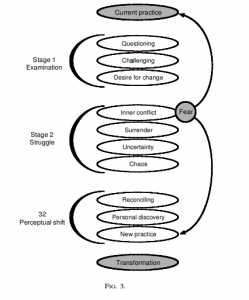 emotional and practical process of critical reflection.(Larrivee, B. 2000) In future reflections both as an academic and a practitioner, I will follow this reflective process and in addition I’ll add a fourth stage to include reflective blogging which has been identified as a valuable tool. PGCAP assignments provide an opportunity to reflect on teaching and learning concepts to identify how I can incorporate different philosophies when forming my own pedagogy. I intend to continue to blogging when reflecting on my teaching practice to identify the changes required, difficulties faced and my change in acuity when achieved. (Larrivee, B. 2000)
UKPSF Dimensions – A5, V3 and K5
Reference List
(2000) ‘Transforming Teaching Practice: Becoming the critically reflective teacher‘, Reflective practice, 1(3), pp. 293-307. Available at: https://www-tandfonline-com.ezproxy.is.ed.ac.uk/doi/abs/10.1080/13562517.2013.860111 (Accessed: June 2018).
McCabe, A., and O’Connor, U., (2013) ‘Student-centred learning: the role and responsibility of the lecturer’, Teaching in Higher Education, 19(4), pp. 350-359. Available at: https://www-tandfonline-com.ezproxy.is.ed.ac.uk/doi/abs/10.1080/13562517.2013.860111 (Accessed: May 2018).
Further Reading
Kreber, C. (2005) ‘Reflection on teaching and the scolarship of teaching: Focus on science instructors’, Higher Education, 50(2), pp. 323-359. Available at: https://link.springer.com/article/10.1007/s10734-004-6360-2 (Accessed: July 2018)