Category Archives: Uncategorised

Reflective commentary on PADP (Academic Identity) – Block 1

I consider my Academic Identity, prior to embarking on PGCAP and writing the Personal Academic Development Plan (PADP), to have been very restricted. I focused solely on teaching, the “job description” and the “contract” obtained. (Boyd and Smith, 2016) I believed that as a lecturer of a clinical discipline, it was my role to transfer knowledge to my students in order to teach them how to become Dental Hygiene Therapists. The only mode of action was via lectures and my focus was on “practice” rather than “identity”. (Boyd and Smith, 2016)

For me to achieve status as a successful and accomplished academic, consideration and prioritising the role and identity of an academic requires “reflection”. (Boyd and Smith 2016) Areas that I recognise as my role within my academic identity are;

  • To support and develop student learning
  • Research responsibilities

To support and develop student learning

I have identified the need to create learning environments that allow students to build their own knowledge and understanding of the discipline. Regurgitation of facts, learned verbatim, is a demonstration of ability to memorise facts but does not verify understanding. Within my teaching I want to generate learning opportunities that support students to build their knowledge. The success criteria of this strategy will be measured by the students’ demonstrating their ability to respond independently and confidently to real time issues that patient cases present.

I have utilised Top Hat in my teaching this semester thus allowing students to share their ideas and opinions on subjects such as patient care and professionalism. Although we have very small cohorts and verbal discussion is easily achieved, I often find that the more confident students engage in discussion while others merely sit and observe. By employing Top Hat, I enable all students are to give input (anonymously) without fear of making mistakes publicly. My aim in using this teaching tool is to increase participation from all students in a non-threatening forum.

I have also developed a deeper understanding and appreciation of the importance of errors in learning and teaching process. Students strive to constantly impress and achieve perfection and fear any form of failure or negative feedback. Shifting mindset would benefit students learning if they are focused on accepting errors and failure as an integral part in the construction of knowledge.

Peer assisted learning (PAL) is an approach to learning and teaching in which students support one another through feedback and collaborative study. I benefitted from being paired with a colleague from the student association, at a PGCAP orientation course. Her role is to support schools, staff and students in the integration of PAL in the curriculum and timetable and she was willing to meet to discuss the how I might best utilise it. PAL would integrate well in clinical skill teaching as students are responsible for independently arranging sessions to practice technical skills such as restorative dentistry and give feedback to one another, thus improving communication skills and learning how to identify weakness and strengths in restorative dentistry processes. I plan to contact my peer this forthcoming semester and discuss with our team as to how we can best integrate PAL.

Research responsibilities

Boyd and Smith’s (2016) paper on researcher identity of higher education lecturers in health care professions reflects my insecurities with beginning research with little to no experience. The paper recognises that many health care professionals like me, enter academia from a successful career in patient care, rather than from further education such as a PhD.

My PT advised that through PGCAP I could begin to introduce research into my academic identity through “research your teaching” course. I have since completed the initial orientation for the course and feel confident that I can contribute to discipline development through my own research. I am also inspired to consider other data collection techniques such as collage making in response to a question. I noted from own experience of this technique that my answer to the question “what does PGCAP mean to me?” was significantly more in depth and enlightening than if I had been presented within a questionnaire.

In the time since first writing my PADP, I have had the opportunity to be a sub-investigator for a worldwide, randomised, double blind, placebo control trial (the Willow study). Although my role is quite far down the hierarchy chain, I hope to gain a lot of insight into the process of research, particularly areas of ethical approval which I have l ittle awareness and understanding of.

UKPSF dimensions – A1,  A2,  A4, A5, V2, K2, K4 and K5

References

Boyd, P. and Smith, C. (2016) “The contemporary academic: orientation towards research work and researcher identity of higher education lecturers in the health professions”, Studies in Higher Education, 41:4, pp. 678-695.


Block 3 – Rationale for Course Design

For Block three course outline assignment, I elected to redesign a course within BSc Oral Health Sciences. Reflecting on my proposed developments for Clinical Practice, I referred to Ramsden’s (2003) journal “issues for addressing”. Ramsden (2003), poses questions which I utilised when considering how the Clinical Practice 2a (CP2a) might be developed.

1 “Goals and Structure” and “Evaluation” (Ramsden,2003)

The nature of teaching of restorative skills lends itself nicely to peer interaction and feedback. It is essential that students are able to identify why a cavity design or restoration placement may fail. In addition, students must also understand the process needed to achieve a successful preparation and restoration of a carious tooth. This is an evident “goal” within the course which students are required to achieve. (Ramsden, 2003)

In the past, I have found that students are often reluctant to present work that they deem as failure. We must assist our students in recognising the value and benefits of presenting failures and successes, as both are valuable in the learning process. Through peer feedback on clinical tasks, students are required to identify areas for improvement in the integrity of a restoration, demonstrating recognition and knowledge of gold standard restorative dentistry. I have considered the feedback element of the course design and the incorporation of “evaluation” from both peers and teachers. This adjustment encourages the student to focus on the desired goal of achieving the clinical competency. (Ramsden, 2003)

An important consideration when engaging in peer feedback is ensuring that students feel secure when carrying out such an exercise. Students should not feel judged as inadequate or unable to give constructive criticism to close peers. This is a fundamental measure of students’ development as a medical professional; effective communication. To avoid these potential problems, students are invited to record and submit the feedback. The teaching staff will review this periodically whilst discussing their own feedback on work that has been presented.

This current academic year, I have begun to incorporate ideas from the course design into my own teaching of Clinical Practice 2a. Trialling the recording of feedback (on paper within hard copy of the restorative handbook), students have utilised the feedback recording tables, thus allowing them to reflect on areas for improvement. This has given students autonomy and independence during self-directed and revision sessions. Students use the individual feedback to personalise timetabled revision sessions, where they are able to focus on their own specific development needs. This allows students to optimise their clinical practise time and work on individual clinical skills that they have identified for themselves rather than clinical tutors setting broad tasks.

  1. “Teaching strategies” (Ramsden, 2003)

Traditionally, CP2a was arranged in the following format; a lecture was delivered on a specific clinical skill followed by a practical demonstration. The remaining time allowed students to practice the skill on the phantom head. This traditional organisation can be ineffective for the student in terms of grasping the concept theoretically and practically as the time is insufficient.  Through the introduction of video demonstrations, the students can access the content with adequate time to process the material. This prior knowledge will give students increased opportunities, within the clinical skills session, to practice the technical aspects and prepare any questions in advance.  This is an example of constructive alignment that I have attempted to incorporate into the course design. (Biggs, 1999)

With this alteration, students can use the learning materials available to develop their own understanding of the restorative technique. The student “constructs” (Biggs, 1999) their own understanding of the restorative process through watching the online materials and independent reading of relevant literature and resources. Prior knowledge from students active and investigative learning will optimise the time available for practicing the skill where the session was previously occupied by a lecture. Students will also have increased access to a tutor for feedback and guidance. As a lecturer, the design of the online resources and set up of the clinical skill practical tasks will achieve the “alignment aspect” (Biggs, 1999) of constructive alignment. In addition to feedback, the course will set mock examinations allowing students to experience and practice in an environment simulating real-life. Consideration of delivery of teaching will assist students in achieving the “desired learning outcomes”. (Biggs, 1999)

Over the next academic year, I aim to embark on video recording my practical demonstrations and gradually build an online resource. Current resources are available from fellow Dental Schools in Scotland that I plan to review and utilise. I hope to collaborate with other schools discussing how to successfully create content that will improve teaching and learning.

UKPSF Dimensions – A1, A2, A3, A4, K2 and K4

REFERENCES

Ramsden, P.  (2003) “The goals and structure of a course” in Ramsden, P. Learning to teach in higher education second edition. Oxon: RoutledgeFalmer. pp. 119-121.

Biggs, J (1999), ‘What the Student Does: teaching for enhanced learning’, Higher Education Research & Development, 1(18), pp. 57-75. Available at: http://www.tandfonline.com/doi/citedby/10.1080/0729436990180105?scroll=top&needAccess=true (Accessed 06 Feb 2018).

Block 2 : Fostering learning through assessment

For this last blog for block two FOAP, I am going to discuss fostering learning through assessment. Reading literature and journals on this topic has provided ideas for assessment redevelopment for BSc Oral Health Sciences.

Clinical Practice 3 was assessed by written paper covering the learning objectives of the course. The objectives could still be achieved by overhauling the assessment format to an OSCE (Observed Structured Clinical Examination) model.

An OSCE is a summative assessment requiring students to carry out a practical task or written based submission revolving around several stations. A selection of the stations may be manned where students will perform a task or discuss a situation in front of an examiner, or they can be independent such as identifying an object. Students are given an allocated time in which to answer or perform the task and rotate around each station, there is no opportunity to return to a station.

I believe this style of examination fosters a learning approach to assessment. Carless (2007) mentions tasks within assessment should “mirror the real world”. This is easily achievable with OSCE style assessment, for example students within our discipline are required to demonstrate basic life support skills. Creating a situation/role play scenario with a mannequin requires the student to display the correct procedure whilst assessing their ability to adapt their knowledge to suit different patient ailments. It’s good preparation for real-life medical emergencies, where students would be expected to care for a patient and if required perform coronary pulmonary resuscitation (CPR).

However, there are areas of the discipline we assess in the traditional “simple models” which don’t foster deep learning within our student cohort. (Ramsden, 2003) Anatomy and physiology (AP) is assessed in two hour, six 20-mark questions in which students state their acquired theoretical knowledge. It is evident that students struggle to adopt deep learning techniques when studying this module through the performance in the examination. The factual content of AP is extensive and requires a lot of discipline by the students to manage their study time effectively to cover all content.

When marking AP, students who perform well on the examination verbatim learn lecture slides, like an actor learns a script, and are in a perfectly correct sequence with the lecture slide content. I can sympathise with students as this method may seem like an only option to retain vast amount of facts. Thus, proving the assessment style requires an overhaul to encourage students to adopt a deep learning approach to their studies.

Both Ramsden (2003) and Carless (2007) suggest that including students in the assessment process can help to foster deep learning. Carless (2007) mentions student inclusion in the paper “institutional quality assurance guidelines”, an example he states that student inclusion in assessment process;

“helped them to prepare for their self-evaluation ” and its purpose was “for students to try and unpack the discourse of assessment criteria and develop a deeper understanding of the qualities of a good assignment.” (Carless, 2007)

This example illustrates that student incorporation in standard setting of course assessment allows students to make an educated judgement on what constitutes a good assessment and

therefore how to study to achieve excellent academic results. I can appreciate this concept works effectively for summative essay type assessments.

In my opinion, the current AP examination requires changing to a completely different assessment style. For example, a 50/50 examination paper of single best answers worth one or two marks each (SBAs) and a separate viva/presentation on a topic, instead of the current six 20-mark short answer questions. The SBAs would allow the student to demonstrate their widely acquired knowledge of AP, with any missed or incorrect questions carrying a minimum penalty. The viva requires the student to present to peers and examiners for 5/10 mins on a topic from AP which the student has chosen in advance to research. Examiners and peers would be able to ask questions on the topic at the end of the presentation, allowing the candidate to demonstrate the depth of knowledge on the chosen subject.

This change to the AP assessment would help students to foster learning through assessment, as it is not solely focused on knowledge regurgitation. Through the presentation, the candidate will be able to demonstrate their own interpretation and understanding of the anatomical or physiological topic of choice. Students are expected to communicate and describe physiological conditions as part of their profession. The viva is the initial preparation towards future conversations they will conduct with patients, thus emulating a real-life situation within the viva assessment. (Carless, 2007) The SBA allows the student to demonstrate a broad knowledge of all topics without a huge loss of marks or potential failure for any minor gaps in knowledge. Students could be incorporated into the assessment by assisting with the development of the marking criteria for the viva/presentation.

UKPSF Dimensions –  A3, A4, V1, K1, K2, K3, K5 and K6

Reference List

Carless, D. (2007) ‘Learning-orientated assessment: conceptual bases and practical implications’, Innovations in Education and Teaching International, 44(1), pp. 57-66. Available at: https://www.victoria.ac.nz/education/pdf/david-carless-3.pdf (Accessed: 30 June 2018)

Ramsden, P.  (2003) Learning to teach in higher education second edition. Oxon: RoutledgeFalmer.


Block 2: Reflective Practice

Reflective practice is an appealing topic for discussion in block two, being a familiar concept within my professional discipline. Reflection on clinical practice is an integral part of the professional registration and practice of a Dental Hygiene Therapist. I originally believed my experiences of being a reflective practitioner would transfer well to PGCAP and my academic role.

Reflection as a dental practitioner is the process of reviewing one’s patient practice. This can be done on a case-by-case basis, reflecting on areas of success and others in need of improvement. The personal findings are used to plan training and continuous professional development for the GDC five year CPD cycle and career development.

From journals, there are similarities between reflection in a clinical environment and teaching. The depth of self-analysis and challenging one’s own beliefs of teaching, is when an academic adopts the status of a “critically reflective practitioner”. (Larrivee, B. 2000)

One of the similarities between reflection as a practitioner and a critically reflective teacher is that it is an infinite process.  (Larrivee, B. 2000) Critical reflection can be adapted to any aspect of professional or personal life and reviewed on a frequent basis, to celebrate success and identify areas for improvement.

It was evident in the literature from Larrivee (2000) that there is considerable “depth” required to achieve critical reflection and the;

“sense of liberation at discarding a dearly-held assumption is quickly followed by fear of being in limbo…In order to break through familiar cycles, one has to allow oneself to feel confused and anxious… Fully experiencing this sense of uncertainty is what opens the door to a personal deeper understanding, leading to a shift in ways of thinking and perceiving.” (Larrivee, B. 2000)

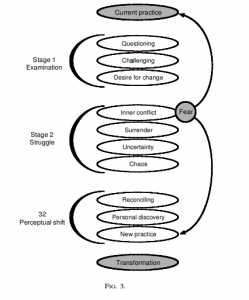
In my previous experience of reflection, the methods I have used in my previous reflection may not have achieved the depth of analysis required to experience the “limbo”, therefore the same issues continue to occur year on year. Until now, reflection has always been about identifying training needs to help overcome practice issues of the job. Transitioning towards critical reflection within my teaching, Larrivee (2000) identifies three stages of the reflective process;

  1. Examination

The initial step in reflection is to assess the efficacy of our “action, reaction or interaction”. (Larrivee, B. 2000)

An example of examination I could adopt in my own critical reflection are the reviewing of my own-recorded lectures. An ability to assess one’s body language, tone, pace and interaction is almost impossible without being able to view as a spectator. This could also be supplemented by feedback given by students who were present and colleagues watching the recordings as well.

  1. Struggle

An “attempting to let go of what is familiar leads to a struggle” which can lead to inner “turmoil”. The “struggle” is learning to alter a “behaviour” which is preventing the positive activities of change occurring. (Larrivee, B. 2000)

Struggling to understand many of the concepts and ideas explored in preparation for PGCAP cast doubt on my ability to do anything other than follow the teaching norms I follow. This led me to feel muddled and nervous about how I would progress through PGCAP and ultimately improve my skills as an academic. (Larrivee, B. 2000)

  1. Perceptual shift

The individual’s acuities have changed, allowing the reflector to see “in a new light”. (Larrivee, B. 2000)

My own “perceptual shift” has occurred throughout the PGCAP process and completion of the different modules throughout the past year. (Larrivee, B. 2000) For example, the concept of “student-centred learning” (McCabe & O’Connor, 2013) has led me to evaluate my role as lecturer and educator. Initially I perceived my role to be the effective transmitter of information to students in order to carry out role of a hygienist and therapist. Through reading of literature regarding “student-centred approach to teaching” (McCabe & O’Connor, 2013), my opinion of my teaching role is now to support and promote students’ knowledge development through learning activities and real life scenarios.  (Larrivee, B. 2000)

Fig 3. from “transforming Teaching Practice” perfectly illustrates the emotional and practical process of critical reflection.(Larrivee, B. 2000) In future reflections both as an academic and a practitioner, I will follow  this reflective process and in addition I’ll add a fourth stage to include reflective blogging which has been identified as a valuable tool. PGCAP assignments provide an opportunity to reflect on teaching and learning concepts to identify how I can incorporate different philosophies when forming my own pedagogy. I intend to continue to blogging when reflecting on my teaching practice to identify the changes required, difficulties faced and my change in acuity when achieved. (Larrivee, B. 2000)


UKPSF Dimensions – A5, V3 and K5

Reference List

Larrivee, B.  (2000) ‘Transforming Teaching Practice: Becoming the critically reflective teacher‘, Reflective practice, 1(3), pp. 293-307. Available at: https://www-tandfonline-com.ezproxy.is.ed.ac.uk/doi/abs/10.1080/13562517.2013.860111 (Accessed: June 2018).

McCabe, A., and O’Connor, U., (2013) ‘Student-centred learning: the role and responsibility of the lecturer’, Teaching in Higher Education, 19(4), pp. 350-359. Available at: https://www-tandfonline-com.ezproxy.is.ed.ac.uk/doi/abs/10.1080/13562517.2013.860111 (Accessed: May 2018).

Further Reading

Kreber, C. (2005) ‘Reflection on teaching and the scolarship of teaching: Focus on science instructors’, Higher Education, 50(2), pp. 323-359. Available at: https://link.springer.com/article/10.1007/s10734-004-6360-2 (Accessed: July 2018)

Block 2: Student-centred learning/active learning

Student-centred learning is;

“a shift in responsibility from lecturer to student with the latter assuming greater ownership of their learning.” (McCabe and O’Connor, 2014)

In my opinion, student-centred learning as described by McCabe and O’Connor (2014) is the essence of why students choose to study at higher educational level. The student is responsible for their own learning and development through attendance at lectures, tutorials and independent study. Students have selected to enrol on a programme; undergraduate, masters or PhD, in their own specific interest. There is no legal requirement to attend university as there is of primary education, but an assumption they will engage in independent learning through choice. However, through closer reading and PGCAP orientation, it is my role as a lecturer to assist the “shift in responsibility” (McCabe and O’Connor, 2014), which can especially be a challenge to students who matriculate as school leavers. It is not enough to give all learning content on lecture slides, but a creation of “learning environments” (Biggs,2017) to allow students to take “ownership of the learning” (McCabe and O’Connor, 2014). My interpretation of “ownership of learning” (McCabe and O’Connor, 2014), is that students can establish their own effective studying/learning styles through a variety of teaching techniques introduced by the lecturer. Solely lecturing from slides alone will not inspire students to conduct their own further reading or interest.

As I have discussed previously, the BSc programme is predominantly set by the General Dental Council (GDC), this has often clouded my opinion that knowledge transmission via lecture is the only way to ensure that all content is successfully covered. If all content is on slides and discussed/delivered within a lecture, students will have all they require to succeed. This style of teaching has led to “conditioned success through mimicking and regurgitating” (McCabe and O’Connor, 2014), which is often demonstrated by students learning lecture slides like theatrical scripts without ability to utilise the data in a problem-solving situation. By adopting a student-centred approach and creating a teaching space where students have the “freedom to make mistakes in a controlled environment” (McCabe and O’Connor, 2014), I the lecturer, can aid and guide the discussion but allow students to “assume full responsibility for the construction of their knowledge”. (Elen, et al. 2007)

I share the transactional view as illustrated in Elen, et al.(2007) paper on “Student-centred and teacher centred learning environments: what students think”. As a lecturer and teacher my “responsibilities” aren’t decreased “but a continuous reassessment and reorientation of these responsibilities and tasks.”(Elen, et al. 2007) Movement away from traditional lecturing does not leave the lecturer without a purpose but an opportunity to adapt learning activities to suit the variety of student learning needs and promote deep understanding of concepts.

Integrating student-centred learning into the current programme

BSc OHS is a programme that lends well to a student-centred approach to teaching and learning. Lecturers from the 2014 study conducted by McCabe and O’Connor utilised group work, blended learning and peer teaching. Some of these techniques I currently use for teaching and subconsciously adopt the student-centred approach, but often revert to the didactic style when I struggle to think of innovative ways to teach a concept. However, from my reading I have realised the adopting a student-centred approach can be a straight forward as changing the layout of the teaching environment in terms of seating. (McCabe and O’Connor, 2014) I plan to make gradual changes to my teaching to move towards a student-centred approach as much as possible, for example recording excerpts of lectures for students to watch prior to a lecture/tutorial so that students have prior knowledge and will engage more in discussion than if the information has been delivered in that instant. I anticipate this will promote a “student-centred approach”, as students can elect to engage with video material prior to the tutorial, so that they have prior knowledge in preparation for in class discussion and clarification with the lecturer.


References

McCabe, A., and O’Connor, U., (2013)Student-centred learning: the role and responsibility of the lecturer’, Teaching in Higher Education, 19(4), pp. 350-359. Available at: https://www-tandfonline-com.ezproxy.is.ed.ac.uk/doi/abs/10.1080/13562517.2013.860111 (Accessed: May 2018).

Biggs, J (2017), ‘Aligning teaching for constructing learning’, The Higher Education Academy. Available at: https://www.heacademy.ac.uk/system/files/resources/id477_aligning_teaching_for_constructing_learning.pdf  (Accessed: 06 Feb 2018).

Elen, J., Clarebout, G.,  Léonard, R,. and  Lowyck, J. (2007)Student-centred and teacher-centred learning environments: what students think’, Teaching in Higher Education, 12(1), pp. 105-117. Available at: https://www-tandfonline-com.ezproxy.is.ed.ac.uk/doi/abs/10.1080/13562510601102339 (Accessed: May 2018)


UKPSF Mapping Proforma


UKPSF self-assessment
Criteria

Areas of activity

Please give 1-2 examples from your practice of how you can show evidence that you cover all the areas of activity
A1. Design and plan learning activities and/or programmes of study


From techniques learned within PGCAP foundation modules, I have begun to implement different learning activities to improve the teaching of the Case Based Learning Module (CBL). I have identified the need to include activities to promote student engagement. CBL has potential to move to a completely online module and has previously been taught in the traditional face to face lecture. To progress CBL to an online module, use of a discussion board on Learn where journals/articles for the session are made available at least a week in advance. A task/question would be set for students to blog about in preparation for the scheduled online discussion. Students would have a Virtual Classroom session (Collaborate) and would be required to participate in a discussion on their well informed and researched answers to the set task/question. This would allow students to share knowledge they have gained from their own research with their peers and tutors.
A2. Teach and/or support learning


I am directly involved in the delivery of lectures within a tutorial style setting for all modules within the BSc program.

I am also involved in teaching of clinical practical skills within a phantom head suite. This involves practical demonstrations of clinical techniques using overhead projections. Students are given feedback and support with their practical techniques on a one to one basis. Students are encouraged to record feedback to assist in the organisation of self-directed learning.

I have arranged remedial theoretical and practical teaching for students who have resit examinations or have missed University due to ill health and other circumstances.

A3. Assess and give feedback to learners


I am a clinical supervisor for BSc Oral Health Sciences. This involves supervising students whilst they carry out assessments and treat members of the public. Students receive private face to face feedback and grading on their performance during the appointments on two criteria domains; professional conduct and clinical abilities. The feedback is given promptly after the appointment to allow the student to reflect on their strengths and weaknesses and establish a goal for future appointments. I focus the discussion on targets for improvement to aid student reflection.

I am an examiner for all written examinations, observed structured clinical examinations (OSCEs) and structured clinical operative tests (SCOT). I am also involved in the development of assessments such as OSCE stations and written questions on subjects I have been responsible for teaching.

A4. Develop effective learning environments and approaches to student support and guidance


Being a student on the PGCAP course has introduced me to several effective learning environments. For example; virtual classroom and discussion boards now implemented for teaching Cased Based Learning (CBL), as was demonstrated in Block 3 of foundations of academic practice.

I am collaborating with a colleague from the paediatric department to create a video resource for paediatric restorative module for Y2. This will involve recording demonstrations of restorative techniques that students can access in preparation for the practical skills tutorial. This will allow for more effective time management in the skills session with optimum time for students to practice and ask questions.

My role as a personal tutor gives me an opportunity to develop effective approaches to student guidance and support. I developed a “crib sheet” for PT staff members within the program to facilitate PT meetings.

A5. Engage in continuing professional development in subjects/disciplines and their pedagogy, incorporating research, scholarship and the evaluation of professional practices


As mentioned in A4 participation in the PGCAP program is an opportunity for me to develop my own pedagogy. I have selected the optional course of “research your teaching” as I have no previous experience of research and I am actively seeking opportunities to help cement a career within academia.

I also regularly attend IAD courses that are relevant to my teaching on a variety of topics; top hat, adding humour to lectures and the learning and teaching conference 2018.

CPD for discipline/professional role are achieved within the 5 yearly cycle as set by the GDC. I am supported by senior staff to achieve all aspects of professional discipline CPD via patient cases, study days and attendance at conferences and courses.

Core Knowledge Please give 1-2 examples from your practice of how you can show evidence that you demonstrate all the areas of knowledge
K1. The subject material


I have had my teaching peer reviewed (POT) back in January 2018 as part of block 2/4 of FOAP. The POT was completed by a colleague from BSc Oral Health Sciences. There was no concern detailed within the feedback from the observer regarding my knowledge of the subject material delivered to students during the lecture.

As clinical educator I must maintain a registration with the GDC (General Dental Council) this involves specific CPD – 150 hours of verifiable (courses, conferences, etc.) within a 5-year cycle.   As clinical educator it is crucial that I keep up to date with current evidence based dental techniques and changes in legislation. This ensures that subject materials delivered are in alignment with current updates in legislation.

K2. Appropriate methods for teaching, learning and assessing in the subject area and at the level of the academic programme


Due to the variety of topics taught within the discipline I utilise many methods to teach students. From traditional lectures, anatomy teaching using 3D visual presentation and clinical practical skills in a phantom head lab using video streaming demonstrations.

When setting questions for assessment I ensure content has been covered within the lectures and that questions have a relevance to “real life” practice, asking students to demonstrate their factual knowledge in response to patient variables. All examination questions are agreed and ratified by external examiners and colleagues to ensure they are appropriately set for academic level of the candidate.

I arrange a revision session for all year groups (often the year group allocated is the same as the PT year group). This allows students to clarify any misunderstandings with the tutor in a face to face setting prior to examinations and is an opportunity for students to share learning and studying techniques.

Reflective portfolio is a session I hold with a year group to discuss patient case management. Students bring details of cases they are currently treating on student clinics. As a group, the students share patient management techniques, communication strategies and research interesting medical or dental conditions that patients present with. In addition, students also develop their reflective skills, which they will be required to complete in their professional work post qualification.

K3. How students learn, both generally and within their subject/disciplinary area(s)


Alongside the revision sessions, I set mock examinations for Y1 written paper (Health and Disease) and Y2 (simulated case). Students find this beneficial as they can experience the examination process prior to the exam diet and test the efficacy of their studying with enough time to modify prior to the real exam.

Student staff liaison committee – is conducted once a semester and is an opportunity to review student feedback and discuss any issues and suggestions students to lecturer and vice versa. Students have a class representative to speak on their year groups behalf. I find the meetings are informative and students conduct themselves in a professional manner.

When teaching the discipline, particularly clinical practice and skills, I teach concepts under the assumption that students are seeing the content for the first time. Students enrol on the BSc programme that have a dental background such as dental nursing (mature students) and others matriculate immediately after finishing school studies. The students with previous dental experience do not have an advantage over those who do not, as the teaching materials and clinical practice time allocation is the same regardless of background. Students are also given extra support wherever required, this is often requested from both groups of students.

K4. The use and value of appropriate learning technologies


Through PGCAP and attendance at IAD courses, I have been introduced to different learning technologies such as Top hat and virtual classroom. Through PGCAP blocks, I have started integrating discussion boards into my teaching. This academic year I have been working on CBL module. CBL will continue as an online module being taught via discussion boards and arranged virtual classroom sessions to improve student engagement. The introduction of technology into CBL will enrich teaching for students and will expose them to other learning and communication environments which are fundamental to their future career as a Dental Hygiene Therapist. It will also support students who have distance commutes for a one-hour tutorial, which can be effectively delivered in a virtual classroom environment.

This year the dental institute has a new state of the art dental surgery with video recording and streaming equipment installed. I can now record treatment being carried out on a patient streamed live to a seminar room next door or can record for future reference. This tool can be used for teaching student’s patient management, communication as well as clinical techniques where it is not feasible to have several students peering over a patient during treatment. There is potential for this facility to be used for assessment in the future.

K5. Methods for evaluating the effectiveness of teaching Peer observation of teaching carried out as part of block 2/4 of PGCAP was an opportunity to have the effectiveness of my teaching evaluated by a colleague who also specialises in my subject area. It was an educational experience being observed which was echoed by my observer. In the post POT feedback discussion, there were techniques and ideas we shared with one another to help improve our teaching.

I value the feedback from students via evasys and the written midterm feedback. Midterm feedback is reviewed by the team and discussed with student representatives at our SSLC (student staff liaison committee) with future actions being trialled. Again, it is an opportunity for teaching techniques to be evaluated and effective strategies to be shared to improve the programme holistically for all students.

K6. The implications of quality assurance and quality enhancement for academic and professional practice with a particular focus on teaching


TPR (Teaching Performance Review), I was not present for the review meeting, but I have been actively involved in the implementation of some of the recommendations such as;

” The Review Team recommends that the Programme Team explores ways to facilitate broken appointment and gaps in clinical diaries created by patient non-attendance, for the further enhancement of student learning. [1.1.7].

When this situation has arisen, I have utilised the found teaching time to discuss recent lectures covered, give students scenarios such as medical emergencies or utilised the clinical skills room to practice techniques. There is also an opportunity for peer assisted learning and feedback, as students who have a failed appointment can observe their peers. It is an opportunity for students to share patient management techniques and give feedback in a professional and constructive manner, as would be expected of them as a clinician.

National Student Survey, midterm feedback and my yearly appraisal via (SOAR) is an opportunity to reflect on QA. Recording comments from colleagues, students and external staff is another opportunity to address any areas of my teaching that can be enhanced by further training.

Criteria Professional Values Please give 1-2 examples from your practice of how you can show evidence that you practice all of the values
V1. Respect individual learners and diverse learning communities As an employee of UoE, I have completed my unconscious bias training module on LEARN and passed the module assessment. This gave me insight to the potential situations that may arise and how to avoid giving a biased response or opinion.

In my role as lecturer and PT, I strive to be an approachable member of staff and encourage students to make contact when they are struggling with a concept; academic or personal. It is important to support students in establishing good studying techniques early on in their academic career through discussion in class sessions and one-to-one in PT meetings.

I encourage students to access support with their learning from the disability services. Students often do not realise there is support for a variety of difficulties. Diverse communities within student populations will present with diverse needs (from mental health conditions to visual impairments).

I have elected to complete the accessible and inclusive learning module for PGCAP. I have selected this course as I can identify that I lack experience and activity for this UKPSF dimension.

V2. Promote participation in higher education and equality of opportunity for learners Within Dentistry, clinic set up can be a challenge for left handed students and clinicians. As a lecturer, I attempt to arrange skills rooms and allocate students equal opportunity to use the left-handed resources and facilities. When demonstrating practical skills, I ensure that I demonstrate the skill both left and right handed.

With enrolment on accessible and inclusive learning PGCAP course, I hope to learn techniques which I can further implement to support BSc OHS.

I am involved in the admissions process and the design of the MMIs (multiple mini interviews). Due to the vast number of applicants and only 10 spaces available, candidates are filtered down to around 70 interviews from the content in the UCAS application. MMI differs from the traditional panel interview, allowing candidates to demonstrate skills at several stations. This allows us to select candidates who demonstrate good communication skills, manual dexterity and traits that are desirable to the role of a dental hygiene therapist which can often be missed in a question-based panel interview.

V3. Use evidence-informed approaches and the outcomes from research, scholarship and continuing professional development My regular attendance at CPD and conferences within the discipline keeps my teaching at the forefront of research and evidence based dentistry. I carefully select training and conferences for topics that will further my teaching of the discipline and broaden my understanding of updates in clinical techniques, materials and equipment available.

I have selected the “research your teaching” module for PGCAP. The summative assessment requires me to draw up a research idea. I plan to look at implementing peer feedback in patient clinic on a trial basis. I will require student input and will invite BSc students to participate in data collection for this.

I have recently been approached to be a sub investigator for a clinical trial, this will be my first experience of the role. I plan to share my experience with colleagues and students, particularly final year students, to inspire them to consider research within their professional career.

V4. Acknowledge the wider context in which higher education operates recognising the implications for professional practice


As a lecturer for BSc, I will continue to teach in accordance with GDC standards and will maintain my own professional development and registration as well.

I will continue to represent the University of Edinburgh at the Directors and Tutor group meetings. The group is formed of all school for teaching of DCPs (dental care professionals) in the UK. It is an opportunity to share pedagogy and discuss techniques and ideas for teaching and assessment.


TPR report OHS 2015 –  https://www.ed.ac.uk/files/atoms/files//ohstprreportfinal.pdf

Reflective response to Peer Observation of Teaching

Lucy Sheerins Observation Feedback Form

Peer Observation of teaching (POT) is;

“A reciprocal process whereby one peer observes another’s teaching and provides supportive and constructive feedback.” (Cairns, Bissell and Bovill, 2013)

My initial experience of POT was a positive one. When the assignment was first issued, I felt nervous about being observed and critiqued during my teaching. My reaction is parallel to the response found by Cairns, Bissell and Bovill (2013);

“All participants admitted some trepidation before being observed and some actually described this as “anxiety”, but in all cases apprehension disappeared as they fell into their regular teaching role.”

This was also reflected in my observers’ comments during the face-to-face discussion; she was empathic to the vulnerability I experienced, as the candidate being reviewed.

In my selection process for the reviewer, I was fortunate to have several members that met the criteria. My observer (ZC) is a colleague who has been in post for over five years and has previously completed PGCAP. I invited ZC to be my observer as she is a colleague with a similar clinical background and has notable experience within academia, currently working towards her PhD.

The lecture selected for the review was delivered to undergraduate year one BSc Oral Health Science candidates on clinical patient presentations. The aim of the lecture was to;

“Introduce the students to the layout and protocol for conducting a patient history. Give the students a template for laying out their presentation to the clinical supervisor, which they are open to interpret and share ideas with the class. Conduct a role play situation where the students can practice conducting a patient history recording and presenting to a clinical supervisor.” (Quoted from pre-observation form)

I selected this lecture as it provided an opportunity to promote student interaction within a lecture and would aid student engagement. The lecture is meaningful and of great value to the students as they are often apprehensive at the prospect of treating patients for the first time. The subject material is detailed within slides, to which students can refer when preparing to attend clinics for the first time.

I sought to create a role-play scenario in which students were able to utilise the information delivered in the lecture and the clinical presentation. I created a dummy patient and issued the students with a completed medical history and relevant clinical and dental information. The concept of role-play may have been more beneficial had I had allocated more time within the lecture for students to team up and practice the scenario. I chose to request volunteers to demonstrate to the whole class but this lead to me having to select a student to participate as there were no willing volunteers.

Within the feedback from ZC she discussed the integration of videos or other media to aid student engagement. I am in complete agreement that there is significant potential for media to be introduced into the lecture. During the post observation discussion with ZC, we brainstormed ideas including a pre lecture video with examples of excellent patient presentations and presentations that were less successful. This would allow the student attending the lecture to gain prior knowledge of the process. In addition, students may be more willing to participate in role-play scenarios having viewed a video demonstrating good practice and thus know more of what is expected. The video could be designed in the style of a hazard perception test, where students would identify positive and negative aspects of the consultation and share their feedback and opinions on an online discussion board prior to the lecture.

In the pre-observation form, I mentioned my concerns over pace and time management. I often feel my lectures are completed more quickly than delivered by my peers, however my observer didn’t find any concerns in this area. In the weeks since the POT, I have reflected upon this concern and feel it may be due to a variety of factors;

  • Students arrive with limited prior knowledge of the subject area and so the lecture becomes an information overload. Less confident students may they feel overwhelmed and not secure enough to engage in discussion or ask questions processed the subject information. Setting a small pre-task such as a question or study text would help the students to prepare more effectively and alleviate this. The lecture time will then be used to cover areas that have not previously dealt with in the task.  Effective lecture preparation will enhance the students’ comprehension of material covered in the lecture and thus build their confidence when asking questions and engaging in discussion. Depth and discussion within lectures should therefore increase, thus pace of the session will be dictated by the student’s demonstration of understanding.
  • Having too many lengthy slides was mentioned within my POT feedback. The subject I chose for my observed teaching contained a large amount of important information to be taught and I felt that the students required all content to be detailed within the slides. This allows students to refer to the process and content at any point during preparation for clinics. However, I do firmly agree that moving away from text heavy slides is important, not only in terms of lecture pace but in engagement as well. Students have the capacity to record lectures electronically as in addition to taking notes; therefore if all content is not detailed on the slides it may encourage the student to engage more actively in the lecture. This may not directly impact on the pace however, through improvement in student engagement, the pace again will be dictated by the learners’ needs.

Post completion of the POT, I have been gradually trialling the introduction of different techniques to help students engage more fully in their lectures. Case Based Learning module (CBL) involves studying current and relevant literature or patient cases. The first part of the CBL session involves the students reading the paper or case, which is then followed by a discussion on the topic. This previous arrangement had a similar result, to the POT lecture, regarding limited student participation. I accept that this is due to the students having minimal time to digest the CBL materials, before having to present an opinion or solution to the task/topic.  I have adapted the format by publishing the papers for the review via an online discussion board and inviting students to share their views on the subject prior to the lecture. Students are encouraged to comment on one another’s blog posts and I also gave individual feedback. When students arrived for the CBL session, an open debate regarding the subject was held. Students were keen to initiate discussions and didn’t require the usual cajoling to contribute their ideas. I shared the idea with members of the teaching and they have reported achieving positive experiences with other year groups when adopting this approach. Our lecturing team are now planning to make CBL an entirely online module with the introduction of virtual classroom, optimising student and staff time and resources.

Overall, POT has increased my confidence in my lecturing abilities and continues to inspire me to  develop my teaching techniques and create better learning environments.


References

CAIRNS, A., BISSELL, V., & BOVILL, C. (2013) Evaluation of a pilot peer observation of teaching scheme for chair-side tutors at Glasgow University Dental School. British Dental Journal. 214, 573-576. Available online: http://www.nature.com.ezproxy.is.ed.ac.uk/articles/sj.bdj.2013.527 Accessed: Feb 2018


Block 3 week 4 – Course Outline

Course name

Clinical Practice 2(a)

Normal year taken

Semester 1 of Year 2

Course level (UG/PG)

Undergraduate

SCQF credits

15

SCQF level

Level 9

Total contact teaching hours

Lectures 35 hours
Supervised practical/workshop/studio hours 60 hours
Summative Assessment 4 hours
Formative Assessment 15 hours
Online Activities 16 hours
Programme level learning & teaching hours 3 hours
Directed & independent learning 17 hours
Total 150 hours

Short course description

Students will continue to develop periodontal treatment skills on patient clinics (from semester two of year one) and begin carrying out treatment on paediatric clinics. Students will be introduced to restorative dentistry techniques within the remit of a Dental Hygiene Therapist in accordance with the General Dental Council (GDC) standards framework. Students will carry out practical skills in the phantom head suite. Students will be introduced to geriatric dentistry and the specific needs and considerations required to treat an ageing population.

Learning outcomes taken from original course outline as in line with GDC standards framework ( I have added a 6th one)

  1. Be competent in the evaluation of caries and management of the teeth and supporting structures.
  2. Have knowledge and show understanding of the factors affecting oral healthcare of the ageing population.
  3. Have knowledge of the range of dental materials available and relevant indications for their use.
  4. Safely carry out caries removal and demonstrate use of appropriate dental materials to restore the dentition.
  5. Demonstrate competent dental management of the child patient using a range of communication and clinical skills.
  6. Be competent in the identification of patient factors and restoration failure.

Components of assessment

Written Examination

Short answer test, Objective Structured Clinical Examinations (OSCEs)

30%
Coursework

Reflective blogs, participation in online discussion.

10%
Practical Examination

Clinical assessment, OSCE, Structured Clinical Operative Tests (SCOTs)

60%

Course description

As students’ progress through the first semester of year two, there is an increase in the number of sessions on patient clinics treating periodontal disease. Students will continue to complete clinical competencies in treatment tasks and administration of local anaesthetic.

Students will begin treatment on paediatric clinic, developing communication and management skills for the niche cohort of patients. Students will carry out oral hygiene instruction, give diet advice and apply fissure sealants for patients as necessary.

Students will commence the theoretical and practical training in restorative dentistry as detailed in the of practice of the Dental Hygiene Therapist as set by the GDC. Students will attend lectures on biomaterials and caries management. Students will be required to view online video demonstrations in preparation for practical clinical skills sessions. Students will participate in an online reflective blog, sharing pictures of work they have carried out in clinical skills. In addition, students will be required to participate in peer assessment and give feedback to other students via comments on blogs. Students will also receive feedback from supervisors which will be recorded in the Identity System (Professionalism and Clinical marking record system). Collation of the Identity feedback and blogs will create a portfolio that students will utilise when organising their independent revision sessions and to reflect on areas of success.

Students are required to achieve all periodontal clinical competencies prior to examinations in December. Students will be assessed in an OSCE format, 12 stations where candidates will be required to demonstrate a task, discuss a case or answer short written questions. Students will also be assessed on practical clinical ability in a SCOT. The marking criteria will assess the students’ professionalism, cavity design, use of protection, material selection, application and restoration presentation. Students will have access to the marking criteria for the SCOT in advance and will be given a mock examination in preparation.


Reflecting back on the Personal Academic Development Plan – Block 4

What has changed since first writing the Personal Academic Development Plan (PADP)?

Towards the end of the first year of PGCAP, and more than six months from originally writing the PADP, there have been a few significant changes. I have been successful in obtaining a permanent contract as a lecturer with the University of Edinburgh, after previously being seconded for two years from NHS Lothian.

In preparation for the interview, I utilised the PADP and my recently gained knowledge from PGCAP by modifying the blog to supplement an Academic Teaching Portfolio (ATP) (Little-Wienert & Mazziotti, 2017).  An ATP is a document that demonstrates a;

“medical educator’s growth and development through documentation, reflection, evaluation, and change.” And “with careful advanced preparation, organized evidence collection of your educational work, proof of scholarship, and thorough documentation of self-reflection and change, you can produce a successful product that accurately represents your educational belief, accomplishments, and growth throughout your career.” (Little-Wienert & Mazziotti, 2017)

Little-Wienert & Mazziotti, outline ideas and tips on how to effectively formulate an ATP.

9.Think about educational goals and objectives

“A goal is an overarching principle that guides decision making and provides a framework for all your teaching activities.” (Little-Wienert & Mazziotti, 2017)

My educational goal, from the perspective of an academic educator, is to support students to create their own knowledge of the discipline. This will be achieved through a wide medium of teaching techniques and strategies from technology to peer assisted learning. Within my PDAP I have tried to set broad objectives such as the introduction of different teaching techniques to achieve my educational goal. Utilising my acquired knowledge and skills from block three Foundations of Academic Practice (FOAP), has led me to consider and adopt digital teaching resources which create the framework for my teaching objectives. (Little-Wienert & Mazziotti, 2017) Examples of resources I plan to employ are; online modules, the use of blogging and peer feedback on online formative submissions and video resources on media hopper. Integration of digital teaching techniques will further enhance student experience and engagement, which is difficult to achieve through traditional didactic teaching methods such as traditional lectures. In relation to my interview preparation, consideration of educational goals and objectives demonstrated my commitment to enhancing the BSc programme. The job description detailed that candidates should;

“be reflective in approach to identify areas for improvement in teaching and assessment.” And “contribute to the continued development of the curriculum as a member of the Oral Health Sciences team”. (The University of Edinburgh Vacancies, 2018)

Within my application and during the interview, objectives from my PADP and consideration of my ATP enabled me to demonstrate my abilities to support the continued development of curriculum for the BSc programme.

  1. Write down your educational philosophy

Since the embarking on the study of FOAP, I have begun developing my individual educational philosophy. Little-Wienert & Mazziotti, state that;

“Your educational philosophy should guide and inspire you throughout your teaching career. It should demonstrate self-reflection and self-evaluation of your teaching and learning style.” (Little-Wienert & Mazziotti, 2017)

My educational philosophy is that students must be active learners in order to grasp theoretical concepts of the subject. It is my role as an academic educator to create diverse learning environments to meet the range of students learning needs. As a lecturer and personal tutor, I will give timely feedback and endeavour to support students’ academic, learning, and personal needs. In my role as a personal tutor, I will strive to identify students who require additional support before they reach a crisis point.

Within my PADP, I have linked my philosophy of education through my teaching and research objectives and will develop this further through future enrolment on the inclusive learning PGCAP course and through my continued professional development. Again, linking the use of PADP and ATP for the interview preparation, my educational philosophy accomplishes the following skills desired for the position;

“possess skills in managing, motivating and supporting students” and “ensure that innovative teaching materials and assessment methods are developed for the current academic year and developed for future delivery of the course.” (The University of Edinburgh Vacancies, 2018)

Achieving the permanent teaching position now allows me to expand the PADP past the current five-year time frame. In turn, this will allow me to be more aspirational in my objectives for example, consideration of future qualifications and potentially achieving a Master’s in Dental Education. PADP was also a useful tool when preparing for my yearly appraisal. I gave supported responses to the achieved objectives from the previous year including beginning PGCAP for example, the continued development of the Restorative Skills Handbook. My future objectives for 2019 have continued to be inspired by the objectives detailed in the PADP, such as continuing to develop academic writing skills and embarking on collaborative research.

UKPSF Linking and the PADP

For future edits of my PADP, I will endeavour to fulfil all domains of the UKPSF. When completing the proforma, I was pleased that I was able to identify many areas that I was already achieving or had scheduled activities which would lead to the domain criteria being met. I noted that domain V4;

“acknowledge the wider context in which higher education operates recognising the implications for professional practice” (UKPSF, 2011)

In achieving a permanent position, I expect to gain knowledge of the wider framework in which HE functions. At present, I am still establishing an understanding of academic process and university policies that are at an immediately applicable to BSc Oral Health Science (BSc OHS). In order to gain the desired knowledge to fully achieve this domain, I will seek opportunities to meet and collaborate with other disciplines at UoE and the wider HE community. BSc OHS is currently establishing Erasmus linkages with a University in Oslo to share teaching strategies and I am looking forward to joining the project this forthcoming year.

UKPSF covered – A2, A5, K2, K5, V2 and V4

References

LITTLE-WIENERT, K., MAZZIOTTI, M,. (2017) Twelve tips for creating an academic teaching portfolio. Medical Teacher. 40:1, pages 26-30. [online]. Available from: https://doi.org/10.1080/0142159X.2017.1364356 [Accessed: 17 Dec 2017]

THE UNIVERSITY OF EDINBURGH VACANCIES. (2018). Job description: Lecturer in Oral Health Sciences. [online] Available at: https://www.vacancies.ed.ac.uk/pls/corehrrecruit/erq_jobspec_details_form.display_form [Accessed Oct 2018].

HIGHER EDUCATION ACADEMY. (2015) UKPSF Dimensions of the framework. Higher Education Academy. [online] Available at: https://www.heacademy.ac.uk/system/files/downloads/ukpsf_dimensions_of_the_framework.pdf [Accessed Sept 2018]


Updated PADP – Block 1

Personal Academic Development Plan

Academic (research and teaching) vision for the next five years

My vision for the next 5 years is to complete PGCAP and become a fellow of the HEA. On completion I hope to obtain a permanent lecturing contract with the University of Edinburgh. To further support my application for a lecturing position, I wish to embark on research project or an MSc concerning BSc Oral Health Sciences (OHS) student diversity. I have an interest in the educational background of students who embark on the course and the factors that affect their success within the discipline. I would hope that this research could be utilised to target and support students and reduce dropout rates.

My teaching vision is to make a positive impact and contribution to the development of the course, by introducing techniques and technologies that will advance education deliverance and assessment style.

Teaching and Research Objectives

  • Introduction of different teaching techniques
  • Improve formative feedback skills
  • Develop academic writing skills
  • Embark on collaborative research
  • Improve and develop supportive skills as a Personal Tutor

In 2016, I was appointed as a lecturer for BSc OHS on a secondment basis. Meanwhile, I have had opportunities to teach in a variety of mediums; “traditional” lecturing (Åkerlind, 2004), clinical practical skills, and clinical patient supervision. Students generally engage well in the practical aspects of the curriculum, as highlighted in the BSc (Hons) OHS Student Midterm feedback (Y1-3):

Clinical skills sessions; “helps build confidence” and “closely resembles treatment you will carry out”. (Student Y2 BSc OHS 2017)

However, in other theoretically heavy “threshold concepts” (Cousin, 2006) such as Health and Disease, students reported;

“Overwhelming amount of information” and requested “more interactive lectures” such as “short quizzes”.

In response to requests for interactive teaching, I plan to introduce different techniques for teaching and supporting learning in the theoretical concepts of the discipline. This is of high priority within my academic plan. At present my lecturing experience is limited and I am concerned that I do not possess the skills and techniques necessary to support the diverse student learning needs. My own literature-based research into teaching styles such as “learning environments” (Biggs, 2017) will help address the deficit in my teaching techniques. This will in turn aid my portfolio when applying for permanent positions.

An estimated 30% of my teaching time is occupied supervising students on patient clinics. Feedback is given privately to students for each appointment immediately following completion of treatment. My second teaching objective is to further improve my formative feedback skills, ensuring that students have specific and achievable targets to strive towards.

During my undergraduate studies, academic writing opportunities were limited due to the absence of an honours year.  I am now required to develop my skills writing at an academic level to enable myself to provide constructive and appropriate support to my undergraduate students. When advising students on their dissertations and literature reviews, I often consult my experienced colleagues for advice on delivering summative feedback.  I hope that as my experience of writing assignments for PGCAP progress, I will need to rely less on my colleagues for continual support.

Boyd and Smith state that;

“the majority of university lecturers in the health professions have been appointed on the basis of their successful first career in clinical practice” and have “little or no direct experience of involvement in research activity” (2016).

I identify with this statement as it accurately depicts my clinical professional experience before entering academia. Therefore, my third objective is to embark on collaborative research with colleagues in my discipline to examine student diversity issues within BSc OHS and resulting employment as Dental Care Professionals. I hope that research on these issues will indicate further developments in curriculum and teaching, thus assisting undergraduates to achieve employment following graduation.

This year I have been appointed as Personal Tutor to 2017-2018 Y1 BSc OHS students. During the last academic year, a significant number of our students embarked on the appeal process. This led the discipline to reflect on the standards of our Euclid notes and how we approach student’s academic and personal issues. We are fortunate to have very small cohorts of students, improving our ability to recognise quickly when issues arise. My fourth teaching objective is to improve my knowledge of the support services available for students and how to engage with them. I am confident in my ability to recognise when students are struggling, due to the regular face to face contact with BSc cohorts. However, when issues are complex, it is vital that I am aware of the services available and how these can be accessed.

Campaign plan for achieving these objectives

In response to student feedback, my campaign plan includes the implementation of newly researched teaching techniques such as Top Hat (Galloway, 2017), Qwectures and flipped lectures (McQueen, 2016). I will continue to attend IAD development courses and utilise the ‘teaching matters’ blog for advice and examples of these techniques in action. I will share successful techniques with my team to collectively improve student engagement, thus making my colleagues key beneficiaries within my plan. During student summer breaks, I will attend IAD courses and create lesson plans to integrate the acquired techniques in preparation for forthcoming semesters.

Oral Health Sciences curriculum involves the teaching of practical restorative dentistry. I plan to utilise a video camera in clinical skills to create video teaching materials. To achieve this, I will allocate protected time to receive training on use of these technical facilities. I will also collaborate with the BSc teaching team in the shared creation of the teaching materials. The key beneficiaries for the implementation of video resources are the BSc students and teaching team. The students will benefit, as they will have access to the video demonstrations in advance of the practical tutorial, optimising the time to experience hands on practice. The BSc teaching team will benefit from the time saved when giving repeated demonstrations, with more time to give one-to-one feedback on students’ restorative work.

Last semester, I trialled a restorative handbook for semester one of Y2. From experience of the previous academic cycle, I noticed gaps in continuity and uniformity when teaching students restorative skills, as more than one lecturer is involved in teaching the module. The handbook contains diagrams, examples, tasks and lectures that are delivered throughout the semester. I included space for students to reflect on each session within clinical skills, however I rarely witnessed this being utilised. My campaign plan is to obtain feedback from colleagues and students on how to improve the handbook’s efficiency. Personally, I have already identified the need for lecturers to give formative written feedback on tasks carried out, which may in turn encourage students to utilise the written space for reflection. When the handbook is used next semester, I will request feedback from staff and students on the updates that were added. My future ambition for the handbook, is for it to be a fundamental educational online resource and portfolio for students. I would like to achieve this within the next three years, theoretically this should be achievable. I am aware of similar educational tools currently being used by other disciplines within the University, I will contact my colleagues from other schools, for advice on how to create and implement such a resource. An obstacle to achieving this goal within the desired time-frame, will be my training needs in order to develop an electronic resource.

In addition to developing the handbook, during the summer, I can attend training on the use of Top Hat, Qwectures, and Flipped Classroom. The IAD provide face-to-face training and online resources, which makes my objective easily achievable. The objective is also an ongoing process that I expect will continue, for at least, the next two and a half years of my secondment.

Regarding formative feedback, I plan to develop a template for use on clinics. Feedback is currently given verbally by the supervisor and is recorded by the student. The supervisor must electronically sign off the reflective account but there is only room for comment if a low grade has been given. When I think back to my undergraduate training, I valued direction and used it to improve, however positive comments were verbal and rarely recorded. Allowing the supervisor to add comment, regardless of the grade outcome, may support those students who often feel they are only ever given critical feedback. Similarly, this is a task that can be put in place within the summer months when course development activities occur. An obstacle to the implementation of this system, is the addition to the already full workload of the BSc core teaching team. A trial period of supervisor feedback recording can measure the demands on staff workload, but also gauge the benefit to student development, via feedback and audit.

I recently met with my personal tutor for PGCAP to discuss the optional courses. I appreciated the advice and guidance given and have chosen the optional course “Researching your teaching” where I hope to develop my research skills. The course assignment is to write a research proposal, my research domain will be student diversity in dental education. I will seek advice from colleagues who have completed their Masters in Dental Education, on how to develop my research proposal to benefit BSc programme. I hope there will be future opportunities for collaboration on a research project with my colleagues, post my PGCAP completion. In terms of time frame, I project that I will have embarked on a collaborative research project within the next five years. This will be subject to employment opportunities and my performance in my current role.

Identification of key beneficiaries, collaborators and partners

In no hierarchical order, the key beneficiaries within my plan are the BSc programme, colleagues, students and myself.

Conceivably, the most important beneficiaries of my personal plan are the BSc OHS students. Evidence of course adaptations made in response to student feedback, will ensure students feel their opinion is valued and encourage an “ethos of respect” (Kreber, 2010) between lecturers and students. Through improvements in teaching styles using the technology previously mentioned, verbatim “mimicry” (Cousin, 2006) of lecture content by students should decline, as they begin demonstrating a deeper level of understanding in assessments. Students often express an overwhelming feeling of stress, regarding coping with discipline content especially before examinations. Through further PT training and collaboration with colleagues, I will be better equipped to assist and support students in need of academic and personal guidance at exam times.

Personally, I feel I will benefit from the opportunity to begin building my academic identity (Kreber, 2010) and reputation within dental education. I have entered a post in academia relatively early in my career and plan to utilise PGCAP as an opportunity for further academic development and employment.

Key challenges, opportunities and funding

September 2020 is the expected completion date of my secondment. I am fortunate to have the opportunity to complete PGCAP during this time frame however, I expect that the progression of research may extend beyond this date. By securing research funding and collaborating with colleagues who have research experience, I hope to build a robust portfolio to apply for a secured academic position.

Development of the course content is necessary and continuous as the discipline is governed by the General Dental Council (GDC) standards framework. Curriculum is set by the GDC and must be accurately taught, currently in the format of traditional lectures. When adopting new teaching methods, the challenge is to ensure accuracy of information students receive, whilst encouraging them to further their learning through independent research.


UKPSF Framework Dimensions covered – K4, K5, V1, V3, V4


References

Åkerlind, S. (2004) A new dimension to understanding university teaching. Teaching in Higher Education. 9:3, pages 363-375. [online]. Available from: https://doi.org/10.1080/1356251042000216679 [Accessed: 07 Dec 2017]

Boyd, P., smith, C. (2016) The contemporary academic: orientation towards research work and researcher identity of higher education lecturers in the health professions. Studies in Higher Education. 41:4, pages 678-695. [online]. Available from: https://doi.org/10.1080/03075079.2014.943657 [Accessed: 07 Dec 2017]

Cousin, G. (2006) An introduction to threshold concepts. Planet. 17:1, 4-5, pages 4-5. [online]. Available from: http://www.tandfonline.com/doi/pdf/10.11120/plan.2006.00170004?needAccess=true [Accessed: 14 Dec 2017]

Biggs, J (2017), ‘Aligning teaching for constructing learning’, The Higher Education Academy. Available at: https://www.heacademy.ac.uk/system/files/resources/id477_aligning_teaching_for_constructing_learning.pdf  (Accessed: 06 Feb 2018).

Galloway, R. (2017) Teaching Matters blog [online]. The University of Edinburgh. Available from: http://www.teaching-matters-blog.ed.ac.uk/?p=1533 [Accessed: 19 Dec 2017]  

Kreber, C. (2010) Academics’ teacher identities, authenticity and pedagogy. Studies in Higher Education. 35:2, pages 171-194. [online]. Available from: https://doi.org/10.1080/03075070902953058 [Accessed: 06 Dec 2017]


Mcqueen, H. (2016) Teaching Matters blog [online]. The University of Edinburgh. Available from: http://www.teaching-matters-blog.ed.ac.uk/?p=888 [Accessed: 19 Dec 2017]  


Further Reading

Bomberg, E. (2016) Teaching Matters blog [online]. The University of Edinburgh. Available from: http://www.teaching-matters-blog.ed.ac.uk/?p=198 [Accessed 06 Dec 2017]

Brew, A. (2010) Imperatives and challenges in integrating teaching and research. Higher Education Research & Development. 29:2, pages 139-150. [online]. Available from: https://doi.org/10.1080/07294360903552451[Accessed: 07 Dec 2017]

Vitae. (2018) Applying for academic jobs. [online]. Available from: https://www.vitae.ac.uk/researcher-careers/pursuing-an-academic-career/applying-for-academic-jobs [Accessed: 21 Feb 2018]