
When I initially read Cousin’s “An introduction to threshold concepts” I struggled to relate the concept to my discipline and confused concept with a subject division. I reached out for guidance and was introduced to “Threshold concepts in dental education” (Kinchin, et al 2011) which perfectly illustrates how identification of threshold concepts (TC) in a curriculum can positively change the way in which we deliver clinical dental education.
When I think of the word “threshold”, I think of a vast building that I want to explore, but first I must pass the threshold to access these areas.
I find this image helps me to understand the role of TC in dental education, that once students have understood and “pass the threshold” they can expand their knowledge and explore that topical area.
A TC that is well taught within BSc Oral Health Sciences (BSc OHS) is the caries triad. Caries is a multifactorial disease which requires a susceptible tooth, dietary sugar and bacteria to commence. When educating students of this concept we use the following imagery.
Removal of any one factor as illustrated stops the carious process from occurri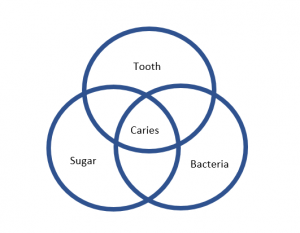 ng or continuing to progress. Once students understand this relatively straightforward concept they can research any of these factors such as species of bacteria, and diet advice for minimising sugar intake. The further research will aid students with patient education which is integral task in their role as Dental Care Professional.
Compared to this easily relatable and readily understood aetiology of the carious process, students struggle with the concept of bonding in restorative dentistry. Students are keen to learn the procedure of tooth restoration due to the rewarding results for clinician and patient. Kinchin et al discuss the “experiential/linear” knowledge structure and “chains of practice that are reinforced by the sequential nature of clinical procedures”, restorative dentistry is an example of such a procedure. Students learn the step-by-step process from caries removal, cavity design, selection of material and placement. By teaching in a sequential fashion, students struggle to adapt their knowledge in order to treat difficult human variants that may arise during real life treatment.
To facilitate students ability to recognise why restorations may fail and how to avoid this, the introduction of TCs is a viable option. For example, a threshold concept within restorative dentistry that I’ve identified is the process of bonding and creating a micromechanical lock. Students confidently remember its place within the sequential process but are often unaware of the crucial importance of this step for the success of the filling. Once the concept bonding is understood, students can expand their knowledge in the area of creating a compatible surface to the variant strengths and weaknesses of bonding products available. With the ability to expand on the concept students will be able to critically evaluate advances in dentistry due to the knowledge grounding from a TC.
In my opinion, TCs are an innovative way to develop curriculum and as I progress through PgCAP to block three, I feel TC could be a key factor to consider when developing a course with regards to knowledge transmission.
An effective method to implement the integration of TCs is the use of flipped classroom (FC) (McQueen, 2016). By means of a recorded lecture you could introduce a TC such as caries triad which students would be required to watch prior to the FC session. Students would then be required to carry out independent research on a factor of the triad such as bacteria species which they will present to the group in the FC session. This also gives the lecturer opportunity to ensure all content is still covered in line with GDC standards and less need for monotonous lecturing for hours on end. van Vliet, Winnips and Brouwer (2015, 2014) research shows that by addition of flipped lecture to;
“one of the five traditional lecture sessions per week appeared to be sufficient to achieve changes in learning strategies of students towards deep-learning strategies”.
This is a manageable target in the implementation of flipped classroom which I can integrate into the discipline and continue to engage and enrich student learning.
UKPSF Framework Dimensions covered – A1, A2, A4 and V3
Reference List
Cousin, G. (2006) ‘An introduction to threshold concepts’, Planet, 17(1), pp. 4-5. Available at: http://www.tandfonline.com/doi/pdf/10.11120/plan.2006.00170004?needAccess=true (Accessed: 14 Dec 2017).
Kinchin, I. M., Cabot, L. B., Kobus, M. and Woolford, M. (2011), ‘Threshold concepts in dental education’, European Journal of Dental Education, 15, pp. 210–215. Available at: http://onlinelibrary.wiley.com/doi/10.1111/j.1600-0579.2010.00660.x/full (Accessed: 09 Jan 2018).
McQueen, H. (2016) ‘Teaching Matters blog’, The University of Edinburgh. Available at: http://www.teaching-matters-blog.ed.ac.uk/?p=888 [Accessed: 19 Dec 2017).
Van Vliet, E. A., Winnips, J. C., &and Brouner, N. (2015), ‘Flipped-Class Pedagogy Enhances Student Metacognition and Collaborative-Learning Strategies in Higher Education But Effect Does Not Persist’, CBE Life Sciences Education, 14(3), ar26, pp. 1-9. Available at: http://doi.org/10.1187/cbe.14-09-0141 [(Accessed 04 Jan 2018).
Door picture – Available at creative commons no attribution required
https://pixabay.com/en/door-open-door-lock-design-brings-1845682/
Triad diagram – Made independently by Lucy Sheerins on Word
Additional Reading
Åkerlind, S. (2004), ‘A new dimension to understanding university teaching’, Teaching in Higher Education, 9(3), pp. 363-375. Available at: https://doi.org/10.1080/1356251042000216679 (Accessed: 07 Dec 2017).
Hi Lucy
I really enjoyed reading your blog, particularly your reflections on how TCs didn’t make sense at first, but then finding a reading specific to dentistry really helped you to make sense of TCs in your own specialism. You articulated really clearly how the examples of TCs in dentistry can be used to reorientate the design of teaching – well done! You also used relevant literature meaningfully in your blog.
best wishes
Cathy