
Within BSc OHS there are many assessment styles I have experienced as an assessor. Our students are assessed in the well-recognised written summative paper style demonstrating factual knowledge. In other areas of the subject, we assess students via a simulated patient case where candidates utilise experience and knowledge to demonstrate ability to treat patients effectively.
Sambell et al. discusses the “principle of authenticity” in chapter 1 of Assessment for Learning in Higher Education 2013, which has led to me consider which attributes of authenticity our assessments promote. I will discuss the authenticity of one of the assessments we set for the year three cohort.
Within the module of Preparation for Practice we now assess students by assigning a public health topic which the student must research and design a poster on. A date is then set where the posters are presented by the candidate in a ten-minute presentation. Students are graded not only on the poster content and appearance, but also on their presentation skills i.e.. eye contact and audience engagement.
Using the Prism of assessment design (Saunders, 2014) I want to measure the “authenticity” (Sambell et al., 2013) of this approach to assessment.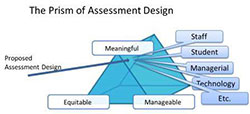
Meaningful
A meaningful assessment is one that assists students to achieve the learning objectives (Biggs, 1996). One of the learning objectives for Preparation for Practice;
“Communicate appropriately, effectively and sensitively by spoken, written and electronic methods and maintain and develop these skills.”
In my opinion the poster assessment is an opportunity to develop communication skills when presenting to the assessors and peers. It is also an opportunity for students to think creatively using digital methods to convey a health message and information which is an integral role of a Dental Hygienist and Therapist.
Equitable
An equitable assessment is one which the “reward is proportional to the effort put in and the skills demonstrated”(Saunders, 2014). In my opinion, students feel motivated to produce high quality work as it is assessed by their peers, lecturers and external examiners. The marks awarded for this assessment count towards the students’ degree classification, thus again motivating students to produce high quality work and presentations. The students may wish to include the poster within a portfolio for future employment applications. It could also be used as an example of independent literature-based research which would support discussions within an interview setting. The BSc programme is often contacted by dental companies and professional bodies offering students opportunities to showcase academic work in a competition. In addition to the prestige of placing in a competition, students may benefit from recognition of their work by the judge (dental/professional body) being detailed within a portfolio for employment applications.
Manageable
For an assessment to be deemed “manageable” it must be “completed and marked in a timely manner, without undue stress for staff and students”(Saunders, 2014). As a team we collectively developed a marking criterion which was shared with students indicating what is required to perform well in this type of assessment. Staff utilise this grid when first viewing the posters and whilst listening to the presentations. A team meeting is held immediately after the presentations and staff discuss their comments and agree on a mark for each category. Having protected time soon after the presentation aids marking as it is still fresh in the assessor’s memory. The only time issue in giving results is the timing of exam board as no results are issued until after ratification.
I feel this is assessment succeeds in many aspects of the Prism of assessment design, however there are many other assessment styles that are utilised in the discipline that do not fulfil the criteria. As I progress through block three I hope to develop a deeper understanding of assessment design that can be used to improve all our undergraduate assessments to emulate authentic attributes.
UKPSF Dimensions covered – A3, A5, V3, V4
References
Biggs, J (1996), ‘Enhancing teaching through constructive alignment’, Higher Education Research & Development, 32(3), pp. 347-364. Available at: http://www.tandfonline.com/doi/citedby/10.1080/0729436990180105?scroll=top&needAccess=true (Accessed: 06 Feb 2018).
Sambell, K., McDowell, L., and Montgomery, C (2013), ‘Chapter 1. Designing Authentic Assessment’, Assessment for learning in higher education [electronic resource], pp. 10-31. Available at: https://www.dawsonera.com/readonline/9780203818268 (Accessed: 14 Feb 2018).
Sauders, F (2014), ‘Designing assessments that are meaningful, equitable and manageable in UK higher education’, Higher Education Academy. Available at: https://www.heacademy.ac.uk/blog/designing-assessments-are-meaningful-equitable-and-manageable-uk-higher-education [Accessed 14: Feb 2018]
Hi Lucy,
Great to see you analysing your practice through the lens of the educational literature, just what we want in these blogs. I agree with you that students can find presenting in front of their peers motivating and that it can push them to perform well. When you develop this post for your summative assessment can you say a bit more about how you know that the learning experience on this assessment was good for your students. Maybe you could say something about the quality of the work they produced or the feedback they have given you on this course?
Best,
Velda